“A necessity, not a luxury” - MSP Stresses Need for Reliable Air Travel to Far North
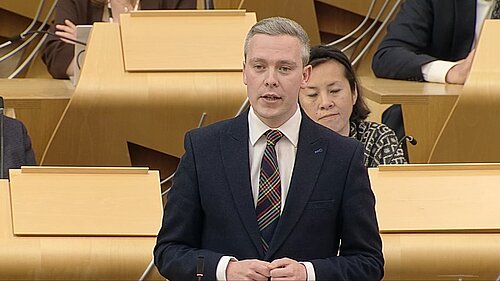
Caithness, Sutherland and Ross MSP David Green has said that long-term funding for flights to and from Wick is essential to help the far north realise its economic potential and encourage people to stay in the region.
In August, funding was secured to run return flights to Wick from Aberdeen and Glasgow until August 2027.
Speaking in a debate in the chamber on Thursday [1 October], Green highlighted that while the Highlands play an essential role in Scotland’s economic future, its potential can only be realised if long-term funding is secured for flights to the far north.
He stressed the need for funding to go beyond next August, saying:
“We cannot expect communities, businesses and passengers to live from year to year, relying on short-term PSO support and wondering whether these vital routes will still be there in the years ahead.
"If we are serious about delivering economic growth across every part of Scotland and ensuring people can access essential services, we need to ensure create certainty for these routes.
"Multi-year funding is, I believe, essential to guarantee confidence in these vital connections, allowing communities, businesses and operators to plan for the long term rather than having to face uncertainty every year.
"So, I welcome the Government’s investment, I thank everyone who has worked to secure it, and I urge Scottish Ministers to build on this progress and bring forward that long-term strategy with the Far North at its heart.”
Full Speech of David Green, MSP for Caithness, Sutherland and Ross:
I thank my friend Liam McArthur for bringing the debate to the chamber and I, too, add my congratulations to Tom McArthur, who will be delighted, I know, to see how significantly he has featured in the Official Report for this evening.
I also put on record my thanks to the Scottish Government for the investment that has been made in services from Wick John O’Groats airport, which has been warmly welcomed in Caithness and across the wider north Highlands. I am pleased that the case that I made to the transport secretary in the weeks after my election was well received, and I genuinely thank him for that early engagement. I also give real credit to the Highland Council, the North Highland Chamber of Commerce, Air Charter Scotland and everyone else who worked hard to secure that agreement. It was their efforts that demonstrated the strength of the local case and the importance of those services to the communities that we all serve.
As one of the most rural mainland regions in the country, reliable air connectivity is not just a luxury for people in Caithness and the wider north Highlands—it is a necessity. People across the far north should not be disadvantaged simply because of where they live. However, for many communities, travelling to Aberdeen by car can take seven hours, and travelling to Glasgow can take eight to nine and a half hours. The routes are about more than simply getting from A to B; they are about supporting economic growth, helping employers to attract and retain staff and ensuring that patients can access essential healthcare services.
We must recognise that the north Highlands also have a key role to play in Scotland’s economy today and in future. From clean energy and the transition from oil and gas to the continuing work at Dounreay, major opportunities exist for investment, employment and innovation. However, those opportunities depend on reliable transport connections. The same is true for tourism and the future sustainability of our rural communities. Good connectivity helps businesses to grow, enables people to access employment and public services, and makes it easier for families and young people to choose to live or remain in or move to the far north.
The withdrawal of commercial air services in 2020 demonstrated just how vulnerable that region is to transport isolation. Digital connectivity is important but it cannot replace the ability to physically move people’s skills and therefore support investment. Although I welcome again the Scottish Government’s investment, I want to make clear that the debate that we are having now must be the beginning of a wider conversation: we need a long-term strategy to support a resilient, sustainable and accessible air transport network across Scotland.
Like Liam McArthur, I am grateful to HITRANS and colleagues in the chamber for exploring potential options through the many international case studies that we have heard about. To create a model that works for the Highlands and Islands will require leadership from Scottish ministers; crucially, that model must be informed by the needs and perspectives of the communities that many of us in the chamber serve. The Scottish Government has taken welcome steps to take that work forward, and I recognise that progress, but there is a need for urgency.
We cannot expect communities, businesses and passengers to live year by year relying on short-term PSO support and wondering whether these vital routes will be there in the years ahead. If we are serious about delivering the economic growth that I spoke about in every part of Scotland and ensuring that people can access the services that they need, the routes will continue to be essential. As I said, multiyear funding is essential to guarantee confidence in these vital connections and to allow communities, businesses and operators to plan for the long term rather than facing uncertainty every year.
I welcome the Government’s engagement and the investment. I thank everyone who helped to secure it, and I urge Scottish ministers to continue to build on the progress that has been made, bring forward a long-term strategy and ensure that Caithness and the far north are absolutely at its heart.
ENDS.