Farmers deserve answers as Carmichael and Green raise concerns over livestock policy and failed funding scheme
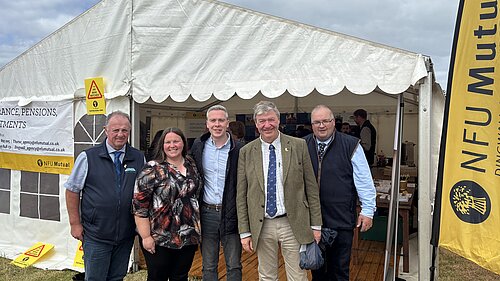
Orkney and Shetland MP, Alistair Carmichael, and Caithness, Sutherland and Ross MSP, David Green, this weekend joined the Caithness show to meet with local farmers, crofters and other business and community leaders, discussing challenges facing rural communities.
Mr Carmichael today warned that the first-ever EU livestock strategy should be a “wakeup call” for both the UK and Scottish governments to set out their ambitions for livestock farming, while Mr Green highlighted ongoing concerns with the Scottish Government’s Future Farming and Investment Scheme (FFIS), and rising input costs for farmers.
The EU strategy sets out five priorities:
- Building a resilient livestock sector
- Strengthening competitiveness
- Supporting more sustainable livestock production
- Recognising Europe's territorial diversity
- Promoting excellence across all production systems
Caithness, Sutherland and Ross MSP David Green said:
"The Caithness Show really is the county at its best, and it was a privilege to meet so many farmers, crofters and agricultural businesses.
"The message we heard was clear. Farmers want to know what the future holds for their industry and they want governments to back that up with action.
"While the EU is setting out a long-term vision for livestock farming, too many farmers in the Far North are struggling to get straightforward answers about support that is available to them here and now.
"The Scottish Government said the Future Farming Investment Scheme would prioritise small farms, crofters and tenant farmers. The huge number of unsuccessful applications across the Far North has left many wondering whether ministers are really listening to the people they promised to support.
"If ministers want farmers to invest in the future, they must provide the transparency and certainty that businesses need to plan ahead."
Mr Carmichael is Chair of the House of Commons Environment, Food and Rural Affairs Select Committee. Mr Carmichael said:
“The new EU livestock strategy should be a wakeup call for both the UK and Scottish Governments. It is past time that they set out their ambitions for livestock farming in this country. Farmers and crofters are rightly going to look at what Europe is now doing in this space and ask, ‘if they can do it, why not us?’
“Under repeated questioning ministers have refused to set out specific goals for livestock farming in the UK. They have been unwilling even to say whether they want the national herd to increase, decline or remain the same in size – which really ought to be the bare minimum you expect as a vision for the future of farming.
“Farming communities on the continent have not exactly been short on criticism for European policymakers in recent years but steps like this show that a change in momentum is underway for agriculture. The question then is whether our own governments can catch up to our neighbours.”
ENDS
Notes to editors:
Photographs of Alistair Carmichael MP and David Green MSP at the Caithness Show attached.
Further information on the EU Livestock Strategy found at: https://agriculture.ec.europa.eu/overview-vision-agriculture-food/eu-livestock-strategy_en
The Scottish Government’s Future Farming Investment Scheme was launched earlier this year to help farmers and crofters invest in improvements that support long-term sustainability, climate action, and environmental goals.
However, data made available to the Scottish Liberal Democrats under freedom of information has revealed 91% (1,421) of the small farms and crofts across Scotland that applied for the scheme received nothing.
- Of the 76 small farms that applied through the Golspie office in Sutherland, just one was successful (99% rejected).
- Of the 99 small farms that applied via the Thurso office in Caithness, just five were successful (95% rejected).
- Of the 168 small farms that applied via the Inverness office, just nine received support (95% rejected).
While the success rate among medium and large farms was higher, farmers across Scotland have said that the allocations made under the scheme have left them “bitterly disappointed”, “confused” and “let down”.
NFU Scotland said there appeared to be inconsistencies in the results. The Scottish Crofting Federation has also raised concerns and called for greater transparency around how applications were scored.
You can find a breakdown of the number of small farms and crofts (under 30 hectares) whose applications were unsuccessful or rejected here.
The Scottish Liberal Democrat FOIs also found that of the 6,326 medium (<30ha/<150ha) and large (>150ha) farms which applied under the scheme:
- 2,558 failed one or more of the eligibility requirements.
- 2,239 were eligible but did not receive a grant from the scheme.
- 1,529 were successful.
You can read more about what farmers have said about the scheme here
Scottish Government guidance on how the funding was supposed to be prioritised included island based agricultural businesses and small agricultural businesses. You find it here.