First Minister challenged on Highland oncology crisis
The First Minister has been warned that NHS Highland’s oncology staffing crisis is the “consequence of a national shortage of oncologists” and has been urged to bring forward a 10-year NHS workforce plan that is “finally fit for purpose.”
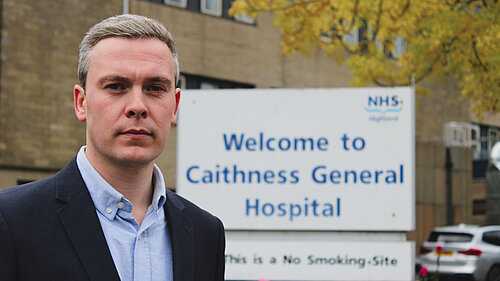
David Green, the MSP for Caithness, Sutherland and Ross, put the challenge to the First Minister during First Minister’s Questions at the Scottish Parliament today [Tuesday 1 September].
Speaking in the chamber, Mr Green said he feared NHS Highland’s oncology staffing crisis is “risking delays to treatment and forcing patients to travel further for care.” He told the First Minister that one constituent recently told him they “like the forgotten people.”
The intervention comes after Mr Green held a public meeting with the North Highland Cancer Information & Support Centre in the immediate days after NHS Highland confirmed its oncology service is experiencing "significant consultant workforce shortages".”
The transfer of selected patients for radiotherapy or specialist treatment to health boards outside the Highlands comes amid growing concerns that services centralised in Inverness appear to be less accessible than ever.
Responding to Mr Green, the First Minister John Swinney said he agrees “that it is best for care to be delivered as close to home as possible.” He added: “what Mr Green has raised with me is an entirely legitimate individual circumstance that my wider reforms are seeking to address…”
The reforms alluded to by the First Minister were later revealed to involve reducing the number of health boards delivering local services across Scotland - a move that could see NHS Highland axed.
Following the exchange, Far North MSP David Green said: "The outcry from patients over these service changes cannot be ignored.
“People across the Far North should have confidence that they can access care close to home. All too often, however, patients are travelling further and spending more time away from home to receive care.
“The Scottish Government has described the crisis as an operational matter, but as I said to the First Minister it is also a consequence of the national shortage of oncologists. The government cannot simply wash its hands of its responsibility to respond.
“I fear that the First Minister’s suggestion that the answer is a centralised superboard represents a deep disconnect with our rural communities. As I have said before, this reduction in services must not become the new normal. People waiting for care today will have received little assurance of that.”
ENDS