Remote Scotland: Spiralling Towards Unviability?
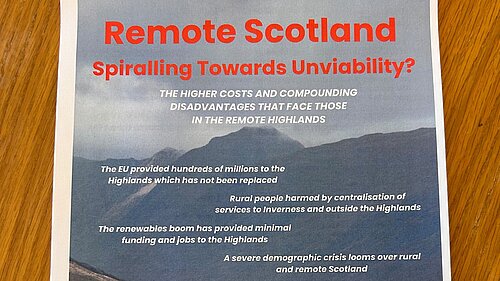
A major new report by Angus MacDonald MP welcomes plans to devolve more powers to the Highlands but warns that Ministers must begin with addressing the unique cost of living pressures facing rural communities, and the necessity to focus on severe demographic challenges.
Published this week, Remote Scotland: Spiralling Towards Unviability? examines what it describes as the Highlands’ growing “cost of living premium” - with families facing higher energy bills, rising transport costs, a worsening social care crisis and declining public services despite lower average wages than many parts of the UK.
Among its findings are:
- One in three Highland households are living in fuel poverty.
- Families in remote areas pay around £1,000 more each year on energy than the Scottish average.
- More than one in five children across the Highland area live in relative poverty.
- The Highlands has lost 18% of its care home beds for older people since 2014 while its elderly population continues to grow rapidly.
- Post-Brexit replacement funding has fallen around 60% short of the value of previous EU support.
The report comes as Prime Minister Andy Burnham has pledged to push more decision-making out of Westminster and towards local communities. Recent reports have suggested the Government is considering new models of devolution for Scotland, including how greater local powers could be delivered to regions such as the Highlands.
Angus MacDonald’s report argues that any new settlement must reflect the realities of rural life, rather than simply replicate models developed for England’s city regions.
The report renews calls for a dedicated Minister for the Highlands and Islands at Holyrood and a cross-government strategy to tackle rural deprivation across housing, transport, healthcare, education, and energy.
Angus MacDonald MP said:
“This report shows that people here face a ‘Highland premium’ at almost every stage of life - from finding childcare, to heating their homes, accessing healthcare, and finding care at the end of life.
“You cannot build a fair devolution settlement without recognising that it costs more to live here. The cost of living is up to 30% higher, incomes are 10% lower, housing is more expensive, public services are less available, there is an ageing population and a dramatic drop in school rolls.
“The disappearance of EU funding has left a chasm, while too many communities aren’t seeing their fair share from the renewables boom.
“These aren’t isolated problems. They are the consequence of years of policies that have failed to account for the realities of rural living. Unless governments begin recognising the true cost of living in remote communities, the gap between the Highlands and the rest of the country will only continue to widen.
“The Highlands cannot be an afterthought in this new conversation about power and place. Andy Burnham built his career on the idea that Westminster doesn’t understand life outside it - well, neither does a settlement designed for Manchester work for Mallaig.
“There is now a real conversation about giving more power to local communities. That’s welcome, but whoever ends up making decisions locally, those decisions have to start with the reality of life in the Highlands.”
ENDS
Notes to editors:
- The full report, Remote Scotland: Spiralling Towards Unviability?, is available for download here
- Scotland received only £212 million through the UK Shared Prosperity Fund between 2022–2025, a 60% shortfall against the EU-equivalent value - for the Highlands specifically, the UKSPF budget was just £9.4 million.
- Writing in The Scotsman on 30 June 2026, Andy Burnham said he wants to give “local leaders the power and resources to connect communities, back young people and revive high streets,” and that his approach means “starting with the life people are actually living”.
- For interview requests or further comment, contact: Lucy Swale, lucy.swale@parliament.uk or 07476373862